There is a question simple enough for a child to understand and powerful enough to reshape healthcare, education, and community life across the country:
What matters to you?
It is a small question with enormous reach. Ask it with sincerity, and the room changes. The person in front of you is no longer reduced to a diagnosis, a demographic category, a chart, a behavior, or a list of risk factors. A fuller human being comes into view. Their priorities surface. Their fears speak. Their hopes gain language. Their values become visible.
At Tellegacy, we believe this question deserves far more attention than it has received. In fact, we believe conversations about what matters should begin as early as Pre-K or kindergarten and be revisited across the lifespan. Children should learn early that life is not only about performance, compliance, or achievement. It is also about meaning, connection, contribution, and the ability to name what truly gives life depth. Adults should keep returning to that same question as life changes, roles shift, health evolves, and relationships deepen.
This is not sentimental thinking. It is deeply practical. It is also a serious health and wellbeing strategy.
Many of the places in the world that have drawn attention for long, healthy lives are often described through the language of community, rhythm, belonging, purpose, movement, and intergenerational connection. The enduring appeal of the Blue Zones idea is not just about nutrition or exercise. It is about the broader structure of life. People tend to do better when they live with meaning, when they are connected to others, when their lives hold a sense of direction, and when daily life reflects what they value most.
That should cause healthcare leaders, educators, caregivers, and policy makers to pause.
If longer and healthier lives are connected to purpose and relationships, then “what matters” cannot remain a side conversation. It belongs much closer to the center. It should shape the way we educate children, prepare healthcare professionals, design services, organize communities, and engage older adults, family members, and people living with complex needs.
The Age-Friendly Health System offers one of the clearest openings for this kind of work through its emphasis on What Matters. That phrase carries unusual wisdom. It does not begin with what the system wants. It does not begin with what is easiest to document. It does not begin with what is most efficient for the provider. It begins with the person.
That is where better care begins as well.
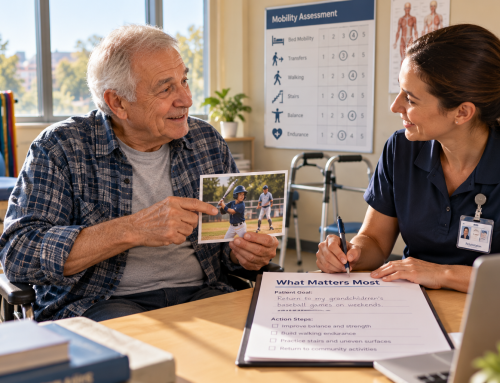
“What Matters” asks healthcare teams to understand the specific outcome, priority, routine, relationship, or way of living that is most important to the person receiving care. For one person, what matters may be attending church every Sunday. For another, it may be walking without fear of falling. For someone else, it may be reading to a grandchild, tending a garden, remaining at home, staying mentally sharp, managing pain well enough to cook, or having the dignity to make their own decisions. These are not minor details. These are often the very outcomes that determine whether care feels healing, alienating, or incomplete.
Yet even this conversation becomes stronger when we understand that what matters does not exist in a vacuum. It lives inside a social world.
A person’s answer to “what matters” is shaped by housing, food access, transportation, family structure, financial stability, education, neighborhood safety, social support, digital access, culture, faith, language, discrimination, grief, and whether they feel seen by the systems around them. In other words, “what matters” is tied to the social conditions of life. It is connected to the Social Determinants of Health.
That connection deserves much more attention than it usually receives.
Too often, the Social Determinants of Health are discussed as external barriers that sit somewhere outside the person. A more human view sees them as the terrain through which a person tries to live out what matters. If someone says what matters is staying connected to family, transportation and technology suddenly matter in a much more personal way. If what matters is independence, safe housing and physical access matter differently. If what matters is dignity, then respectful communication, cultural understanding, and shared decision-making become part of treatment itself. If what matters is living with purpose, then opportunities to contribute, serve, teach, mentor, create, and belong move into the foreground.
This is where Tellegacy has placed its heart.
Tellegacy is built around entering into conversations about what truly matters. It takes seriously the idea that health is affected by relationship, by meaning, by story, by belonging, and by the chance to be known beyond a clinical label. In a world that often moves too fast to listen well, Tellegacy creates space for people to speak from a deeper place. That is where insight often begins. That is where people remember who they are. That is where caregivers, students, providers, loved ones, and communities can hear something that no standard intake form can fully capture.
There is a reason this matters for outcomes.
When people feel heard, they are more likely to trust. When care plans reflect their actual priorities, they are more likely to engage. When providers understand the social realities surrounding a person’s life, recommendations become more realistic. When services align with what the individual is trying to protect or achieve, care becomes more relevant. Relevance changes everything. It influences follow-through, satisfaction, partnership, and the likelihood that a person feels healthcare is happening with them rather than to them.
This is especially important for older adults, underserved individuals, and communities that have often experienced fragmented care, cultural disconnect, or systems that speak over them rather than with them.
A different future is possible.
Imagine if schools taught children how to identify what matters to them, how to listen respectfully when others answer differently, how to connect values with daily choices, and how to revisit those answers through each season of life. Imagine if healthcare students were trained from the beginning to ask about what matters before assuming goals on someone else’s behalf. Imagine if social service programs, aging services, hospitals, clinics, assisted living communities, and community organizations built “what matters” conversations into their routine practice. Imagine if those insights were explored across each area of the Social Determinants of Health so the person’s priorities could guide care in a more complete way.
That approach would change assessment. It would change care planning. It would change quality improvement. It would change how teams define success.
Most of all, it would change the relationship between people and the systems meant to serve them.
This work must remain collaborative. It cannot become another script, another checkbox, or another polished phrase that sounds person-centered while leaving power untouched. What matters should never be prescribed. It should be discovered through conversation. It should be shaped by trust. It should be led by the patient, the resident, the loved one, or the person receiving support.
That distinction is essential.
When institutions decide in advance what ought to matter most, they quietly replace partnership with control. Yet when a person is invited to name what matters in their own words, care becomes more honest and more useful. The provider still brings expertise. The family still brings perspective. The system still brings structure. Even so, the individual’s own voice becomes central rather than secondary.
This is one reason the future of health equity depends on more than access alone. Access matters. Coverage matters. Quality matters. Workforce preparation matters. Even so, if people are served without being deeply understood, major gaps remain. Health equity advances when systems are able to recognize what people value, where social realities are constraining those values, and how support can be aligned with the life the person is actually trying to live.
That is a more mature vision of care.
It sees human beings in context. It recognizes that purpose has health implications. It understands that loneliness, isolation, disconnection, and loss of role can have consequences just as real as many clinical issues. It treats conversation as a legitimate intervention point. It respects the idea that a meaningful life is not a luxury item to be addressed after the “real” medical work is done. For many people, meaning is part of the real medical work.
So here is a challenge for educators, healthcare systems, community leaders, and families:
Ask someone what matters to them.
Ask it slowly. Ask it with respect. Ask it without rushing to interpret or correct the answer. Ask it again a year later, after a diagnosis, after a loss, after a move, after retirement, after recovery, after a child is born, after a spouse dies, after school begins, after school ends.
Then listen for how the answer touches housing, relationships, food, transportation, safety, money, culture, learning, belonging, grief, identity, and hope. Listen for where the person’s values are being supported and where they are being blocked. Listen for what kind of care, curriculum, community, or companionship would help that person live more fully into what matters.
This is bigger than a conversation technique.
It is a way of rethinking health. It is a way of rethinking education. It is a way of rethinking what a humane society ought to ask of itself.
At Tellegacy, we believe entering into conversations about what truly matters can open the door to stronger health outcomes, wiser care, deeper intergenerational understanding, and more meaningful lives. We believe the question belongs in homes, classrooms, clinics, churches, senior centers, universities, public health initiatives, and healthcare systems across the nation.
Because when people are given space to name what matters, they are far more able to live it.
And when more people can live out what matters with the people who matter, health and wellbeing move in a stronger direction for all of us.