Why communication during transitions is now and will be the real frontline of care within healthcare
A “handoff” is not administrative closure. It is clinical care still in motion.
When people leave the hospital, move from specialist to primary care, return home with new medications, or rely on family and community support to carry a plan forward, communication becomes the difference between continuity and collapse.
A woman in her late seventies is discharged on a Friday afternoon after a short hospital stay. Her medication list has changed. Her daughter is trying to listen, write notes, gather the bag, call the pharmacy, and figure out whether her mother needs help getting up the stairs at home. The primary care office has not yet received the discharge summary. The home health agency will not come until Monday. By Sunday, no one is fully sure which medicine was stopped, which one was added, or what warning signs mean they should call for help.
On paper, the discharge happened.
In real life, the handoff was incomplete.
This is one of the most important truths in healthcare today: transitions are treatment. The movement from hospital to home, from inpatient team to outpatient team, from clinician to caregiver, from diagnosis to daily life, is not a side process surrounding care. It is care. It is where plans meet memory, stress, transportation, food access, language, fatigue, trust, and the emotional reality of being human.
Healthcare has spent years treating communication as a secondary matter, a soft skill, or a polished layer placed on top of technical excellence. This view is no longer sustainable. CMS still ties hospital payment to readmissions through the Hospital Readmissions Reduction Program and explicitly points to communication and care coordination with patients and caregivers as part of reducing avoidable readmissions. At the same time, newer CMS models such as ACO REACH are built around coordination across providers, with enhanced benefits that can include telehealth and home care after hospital discharge. Communication is no longer adjacent to value based care. It is one of the main ways value based care succeeds or breaks down.
The evidence is sobering. A recent PSNet review from AHRQ noted that one study across five home health agencies found safety issues in 70 percent of observed hospital to home health transitions. The most common problems included unsafe home environments, medication issues, incomplete information, and lack of understanding of care plans. A 2023 network meta analysis in JAMA Network Open added that discharge from hospital to community is associated with serious patient risks and excess service costs, and that about one in five patients may experience suboptimal or unsafe care around the time of discharge.
This should reframe the conversation immediately.
The danger in a poor transition is not simply that paperwork is delayed. The danger is that human beings are asked to carry clinical plans into real life without enough clarity, support, or connection. AHRQ notes that only 12 percent to 34 percent of discharge summaries reach outpatient providers before the first post hospitalization visit. More than half of patients cannot recall details of their follow up appointments at discharge, only 60 percent can accurately describe their admission diagnosis, and 26 percent receive written discharge information in language that is unintelligible to them. Patients with clear understanding of their post discharge instructions are 30 percent less likely to be readmitted or visit the emergency department.
This is why the most dangerous gap in healthcare is often a conversation gap.
When that gap opens, the consequences spread quickly. AHRQ’s rapid review on structured communication with family caregivers during care transitions notes that miscommunication can contribute to mistrust, caregiver stress, family conflict, medication errors, symptom worsening, delayed recovery, higher emergency department use, and readmissions. That is not a communications problem in the narrow corporate sense. It is, however, a wellbeing problem, a safety problem, a workforce problem, and a systems problem all at once.
Communication during transitions also has to be understood as a social health issue. A safe handoff does not require only the right medication list. It requires a fuller picture of the life the patient is returning to. Can the person get to follow up visits? Is there food at home that fits the care plan? Is the home physically safe? Is anyone available to help? Does the patient understand English well enough to navigate the instructions without fear? Does the caregiver know what to watch for, who to call, and what matters most to the person being discharged?
These are not peripheral questions. CMS built the Accountable Health Communities Model around the idea that stronger clinical and community linkages can improve outcomes and reduce avoidable utilization. In a 2025 JAMA Network Open study of 166,682 Medicare and Medicaid recipients screened under that model, housing stability and transportation needs were associated with higher inpatient admissions, while five of six health related social needs were associated with higher emergency department use. A handoff that ignores transportation, housing, or caregiver realities is not merely incomplete. It is clinically weaker.
This becomes even more urgent in 2026 because the geography of care is changing. CMS has now released nearly five years of data from its Acute Hospital Care at Home initiative. CMS also finalized 2026 outpatient payment changes that expand site neutral payment policy to certain drug administration services and begin phasing out the inpatient only list for hundreds of procedures. Meanwhile, CMS estimates 2026 home health payments will decrease in the aggregate by 1.3 percent compared with 2025. Taken together, these shifts point toward a healthcare landscape in which more care, more recovery, and more risk are moving across outpatient and home based settings. This finding makes the quality of the “handoff” more consequential, not less.
The financial pressure on transitions is rising too. Spending on GLP 1 receptor agonists increased from $13.7 billion in 2018 to $71.7 billion in 2023, a jump of more than 500 percent. When medication costs rise at that scale, medication communication after discharge becomes even more important. Patients and families need honest conversations about access, affordability, side effects, substitutions, and what to do if they cannot obtain what was prescribed. A discharge plan that assumes easy access to expensive medications may look complete inside the chart and still unravel at the kitchen table.
All of this points to a deeper conclusion: a handoff must transfer meaning, not just information.
It should carry forward the clinical facts, yes. Even so, it must also carry what matters to the person, what the receiving team needs to know, what the caregiver is realistically able to do, and which social conditions could make the plan harder to follow. Communication is not successful because a document exists. Communication is successful when understanding survives the transition.
There are already strong models for this. AHRQ’s Re Engineered Discharge, often known as Project RED, was designed to make discharge safer and more coherent. AHRQ reports that RED decreased 30 day readmissions by 25 percent and reduced emergency department use from 24 percent to 16 percent. Its companion IDEAL discharge approach asks teams to include the patient and family, discuss what comes next, educate in plain language, assess understanding through teach back, and listen to and honor goals, preferences, observations, and concerns, with attention to what affects a person’s ability to remain in the community. These are not small process tweaks. They are reminders that humane communication is an evidence based intervention.
The broader research points in the same direction. A 2021 systematic review and meta analysis in JAMA Network Open found that communication interventions at hospital discharge were associated with lower readmission rates, better adherence, and higher patient satisfaction. Readmissions occurred in 9.1 percent of intervention groups compared with 13.5 percent of control groups. Adherence was higher, and satisfaction improved as well. The point is striking: when communication improves, outcomes improve.
There is also an economic case for taking transitions seriously. A 2025 Health Affairs study, summarized by NORC, examined more than 1.6 million hospital discharges eligible for transitional care management and found that patients who received those services had 1.35 percent fewer readmissions, 0.61 more healthy days at home, and more than $500 less in Medicare spending 31 to 60 days after discharge. The gains were more pronounced when transitional care management occurred within alternative payment models. In other words, better transitions are not a drain on system performance. They are part of smarter performance.
Technology can help here, but only if it serves presence rather than replacing it. A 2025 multicenter quality improvement study in JAMA Network Open found that ambient AI scribes were associated with lower clinician burnout, lower cognitive task load, less after hours documentation, and improved ability to provide undivided attention to patients. It matters for transitions because the best discharge conversation is not one rushed by keyboard burden. It is one in which the clinician can look at the patient, look at the family, hear the questions, and notice the hesitation that says, “We do not really understand this yet.”
So where should healthcare go from here?
A five part framework for health systems that want stronger transitions
- Start the transition at admission
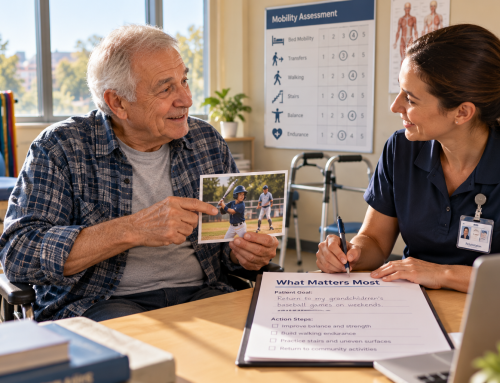
Discharge should not begin on the day someone leaves. AHRQ’s discharge planning guidance emphasizes that planning should begin as early as possible, involve the patient and caregiver, and be reviewed daily. What matters to the person, who will help at home, what the home situation looks like, and what barriers may interfere with recovery should surface early enough to change the plan.
- Treat family and caregivers as part of the clinical team
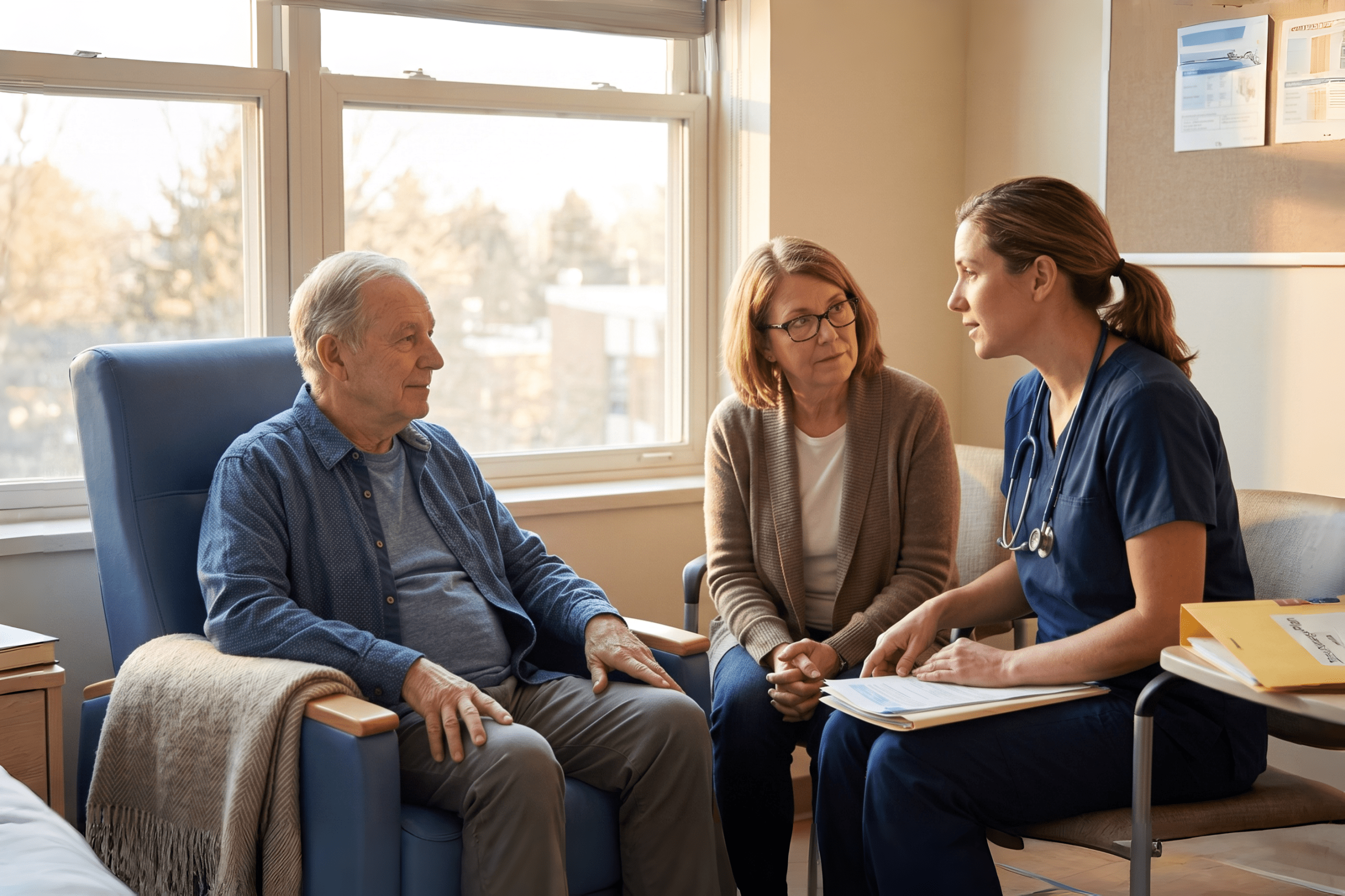
Many patients leave the hospital into the care of people who were never formally trained for the responsibilities they are about to carry. Structured communication with caregivers improves the transition experience and can reduce confusion and burden. Caregivers need practical teaching, warning signs, follow up details, medication review, and clear access points for questions after discharge.
- Build the handoff around plain language and teach back
A good handoff is not measured by how much was said. It is measured by what was understood. AHRQ’s IDEAL model and the discharge communication literature support plain language, small chunks of information, visual reinforcement, and teach back. If the patient or caregiver cannot explain the plan in their own words, the handoff is not finished.
- Transfer social context along with clinical data
The receiving team should know more than diagnoses and orders. They should know whether the patient has transportation, food security, housing stability, digital access, language needs, and someone available to help. This is where social health enters the handoff directly. Clinical and community communication have to meet each other.
- Measure the handoff like it is part of treatment
Health systems should track more than whether discharge paperwork was completed. They should measure patient understanding, caregiver confidence, speed of discharge summary transmission, medication reconciliation success, early follow up completion, social needs identified at transition, healthy days at home, and readmissions. When organizations measure the human quality of the handoff, they are more likely to improve it.
The larger truth
The handoff is where healthcare reveals what it really believes about people.
If a transition is treated as a clerical endpoint, people leave with instructions and uncertainty. If it is treated as treatment, people leave with clearer understanding, stronger support, more honest planning, and a better chance of remaining safe in the world they are actually going back to.
All this is why transitions deserve far more respect than they usually receive. They sit at the intersection of communication, trust, social health, caregiver reality, and clinical risk. They are where the system either narrows into paperwork or opens into partnership.
At Tellegacy, we believe communication belongs in the center of care because human beings do not recover in charts. They recover in homes, in families, in communities, in conversations, and in the fragile days after a hospital stay when what was said must become what is lived.
A handoff is not the end of treatment.
It is where treatment proves whether it can continue with humanity.