The Missing Piece Is the Patient’s “Why”
By Dr. Jeremy Holloway
Social determinants of health screening is no longer a future idea. It is becoming part of the everyday workflow for hospitals, clinics, health plans, case managers, community health workers, and social workers.
CMS describes health related social needs as individual level needs such as financial instability, food insecurity, housing instability, utility difficulties, health care access issues, and transportation barriers. These are the practical realities that shape whether a person can follow a care plan, get to an appointment, take medication consistently, eat well, move safely, and feel connected.
But here is the problem.
Too many screening processes still feel like a checklist.
A patient is asked about food, housing, transportation, utilities, safety, and social support. A referral is made. A box is checked. A form is completed. The data moves through the system.
But the person may still leave feeling unseen.
What the Field Is Trying to Do
Health systems and community networks are working hard to solve this. Many are moving toward standardized screenings, electronic referrals, resource directories, closed loop referral platforms, and care coordination workflows.
Closed loop referral systems are important because they help health care teams and community based organizations communicate, document referrals, acknowledge action, and report whether a patient’s need was addressed.
The evidence also shows why this matters. CMS’ Accountable Health Communities Model connected Medicare and Medicaid beneficiaries with screening, referral, and navigation services. Its final evaluation found lower health care expenditures and reductions in hospital based utilization among navigation eligible beneficiaries.
So yes, screening matters. Referrals matter. Navigation matters.
But the next generation of SDOH tools must go beyond finding needs. They must help people act on what matters.
What Current Tools Are Missing
A case manager should never feel like a transactional conduit between a form and a referral.
The right platform should help case managers, CHWs, and social workers ask deeper, more useful questions:
- What does this person want life to feel like six months from now?
- Which social need is most directly blocking their health goal?
- What small goal would help them feel more in control this week?
- How does this need connect to medication adherence, fall risk, mental health, social connection, or daily functioning?
This is the missing layer.
The screening tool identifies the problem. The referral platform sends the person somewhere. But the care team still needs a structured way to connect the patient’s need to their why, their goals, their confidence, and their next step.
The attached case management material says this well: case managers help assess resources, needs, and goals; collaborate on service plans; support motivation; monitor progress; reduce fragmentation; and help people maintain autonomy and self determination.
That is the work. The tool should support that work instead of flattening it.
Why This Must Happen Now
The urgency is real.
Social isolation and loneliness are connected to serious health risks. The U.S. Surgeon General reported that lacking social connection can increase premature death risk as much as smoking up to 15 cigarettes a day. The same advisory links poor social connection with increased risk of heart disease, stroke, anxiety, depression, and dementia.
AARP also reported that social isolation among older adults is associated with an estimated $6.7 billion in additional Medicare spending each year.
This is why SDOH work cannot stay trapped in paperwork.
When a person lacks transportation, medication adherence suffers. When someone feels isolated, mental health can decline. When housing is unsafe, fall risk may increase. When food insecurity is present, chronic disease management becomes harder. Healthy People 2030 notes that SDOH strongly affect health, wellbeing, quality of life, and the chances of staying healthy as people age.
The Tool We Actually Need
The next tool for case managers, CHWs, and social workers should combine screening, referrals, and human centered goal setting.
It should help the care team move from:
“You screened positive for transportation.”
to:
“Transportation is affecting your appointments, your medication routine, and your ability to stay connected. What matters most to you right now, and what is one goal we can help you move toward this week?”
That shift matters.
A stronger SDOH platform would include screening, closed loop referrals, patient goals, confidence ratings, social connection planning, medication support prompts, fall risk connections, progress notes, and a simple dashboard that helps the care team see the person instead of only the problem.
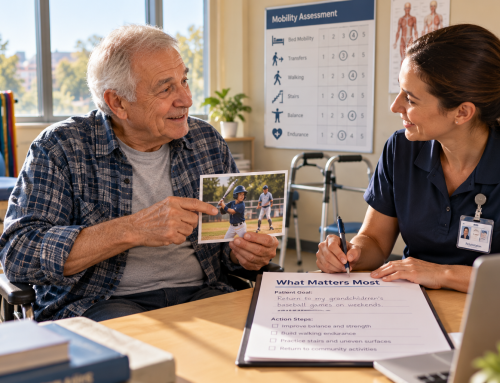
The Age Friendly Health Systems framework already reminds us that care should align with What Matters, along with Medication, Mentation, and Mobility. SDOH tools should follow that same spirit.
The Future of SDOH Is Personal
The future is not more forms.
The future is better follow through.
Case managers, community health workers, and social workers deserve tools that make them feel more empowered, more connected to the patient’s story, and more able to help people move toward meaningful goals.
Patients and clients deserve the same.
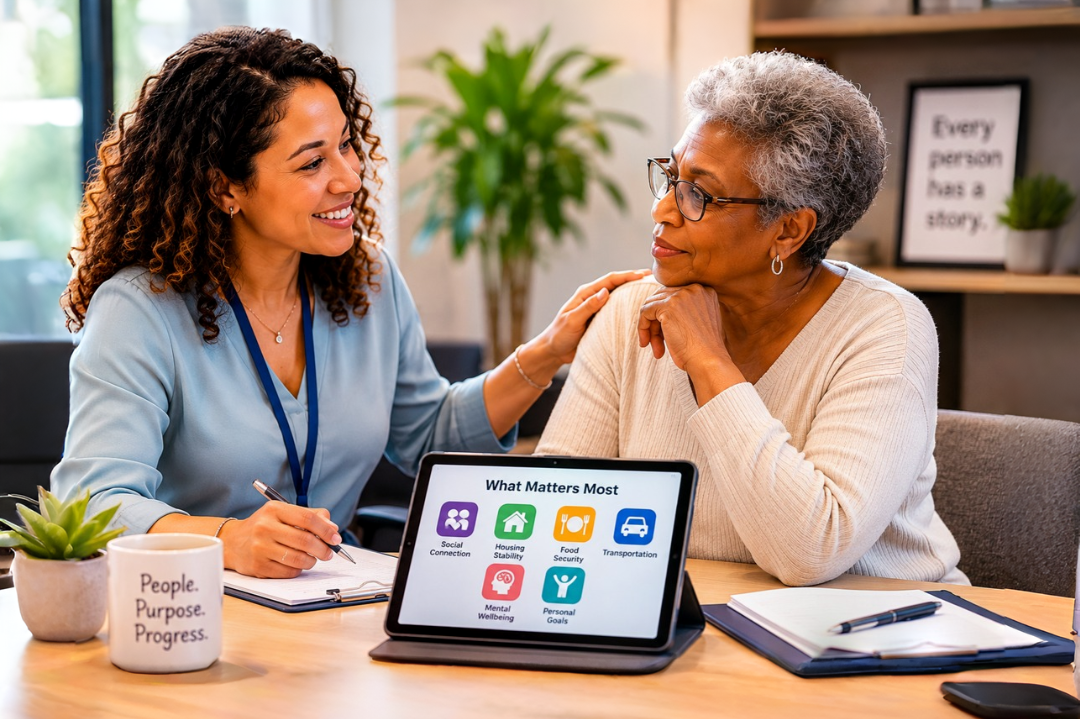
They deserve a process that sees their housing, food, transportation, safety, social connection, medication routine, mobility, and mental wellbeing as part of one life.
At Tellegacy, we believe the next breakthrough in SDOH work will come when screening becomes more than data collection.
It becomes a pathway back to dignity, self efficacy, and what matters most.