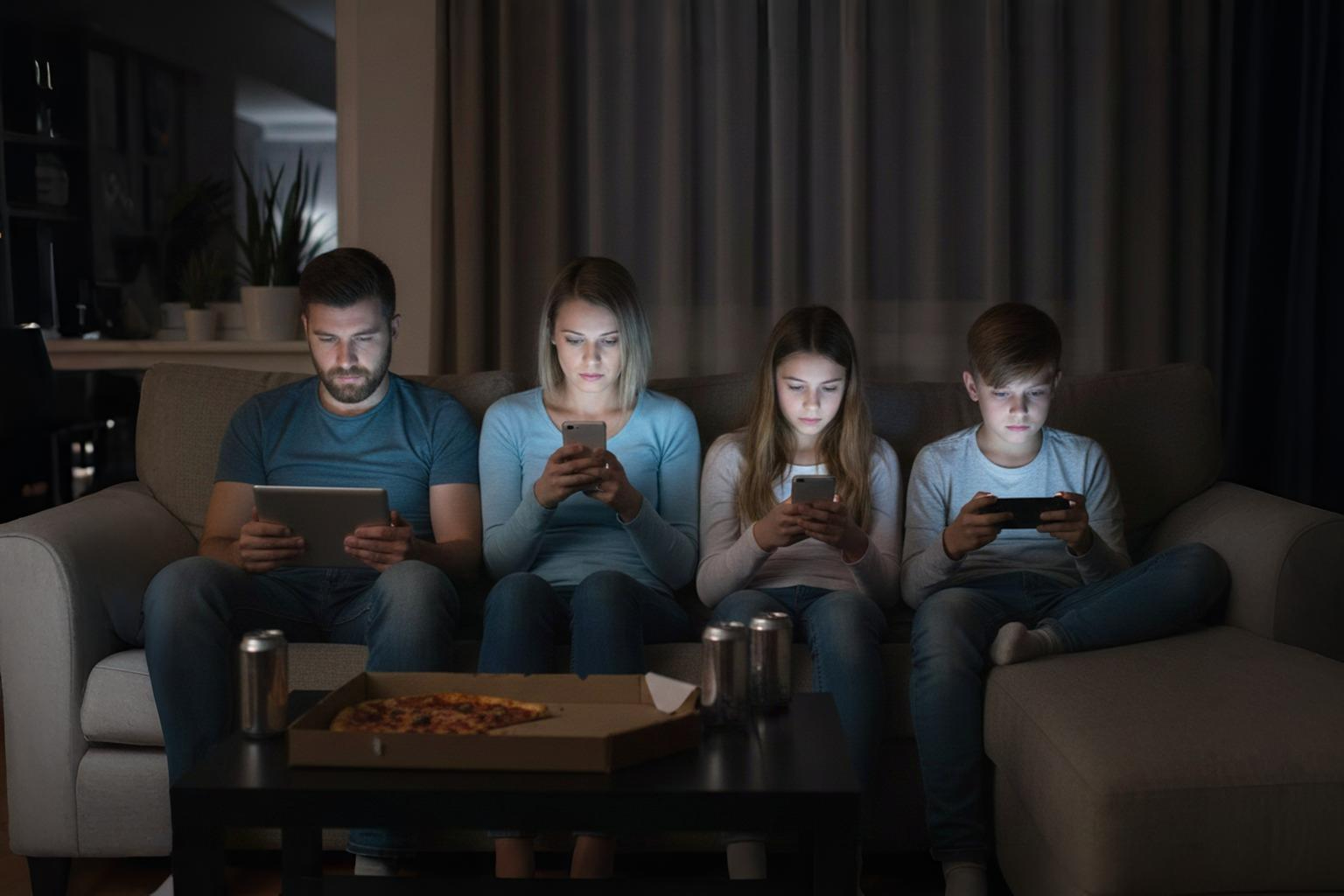
Technology can be extraordinary when human beings remain at the helm. It can extend our reach, strengthen relationships, streamline workflows, and open worlds that were previously inaccessible. Tellegacy was built on that very idea: technology enhances meaningful connection; it should never replace the essence of what makes us human.
But something concerning is emerging across the technology landscape—particularly among some of the most influential AI and social media leaders. Their language, priorities, and product strategies increasingly reflect a model that leans toward assimilation rather than collaboration, with engagement metrics prioritized over human wellbeing. The result is a subtle, powerful pull away from human connection and toward device dependence. And many people don’t even realize it’s happening until the effects are already deep in their lives.
The Growing Drift Away from Human Connection
You don’t need research to know relationships are fraying—but the data is undeniable.
People are slowly losing ties with:
- cousins and extended family
- close friends
- spouses and long-term partners
- parents
- children
In some tragic cases, the disconnection becomes so severe that individuals feel cut off from their own lives entirely.
This isn’t an accident. Many leading tech companies openly describe their goal as maximizing user engagement—meaning more time in the app, on the feed, or interacting with the algorithm. Every minute spent with a device is a minute not spent in human relationship.
And because innovation is accelerating faster than any existing policy, oversight, or ethical structure, these companies understand something their users often do not: the race is to shape behavior before people realize their behavior is being shaped.
Do Tech Leaders Understand the Health Consequences?
Research has been sounding the alarm for years:
- Social isolation is linked to a 29% increase in heart disease and a 32% increase in stroke (Holt-Lunstad et al., 2023).
- Loneliness is associated with a higher risk of dementia and cognitive decline (National Academies of Sciences, Engineering & Medicine, 2020).
- The health impact of chronic loneliness is equivalent to smoking 15 cigarettes per day (AARP Public Policy Institute, 2017).
- Isolation increases depressive symptoms, anxiety, and risk of premature death (Cacioppo & Cacioppo, 2018).
Yet, many AI founders speak in terms that highlight efficiency and scale—but rarely mention relational health, emotional wellbeing, or community resilience. If they study the consequences, they do not speak about them publicly. And if they understand the depth of the crisis, it doesn’t show up in their product design.
Human tolerance for each other is decreasing. Human tolerance for technology is increasing.
That imbalance is not an accident; it is the predictable outcome of attention-driven systems.
Technology Is Not the Enemy—Displacement of Humanity Is
This isn’t a call to abandon innovation. Technology can enhance the human experience when:
- people remain in charge,
- boundaries are set,
- connection—not consumption—is the goal,
- and digital tools support real-world wellbeing.
The danger is not the technology itself.
The danger is allowing technology to quietly redefine our existence.
Humanity must actively fight for its agency.
We need to set boundaries.
We need to preserve relationships.
We need to design our days intentionally.
We need to refuse the narrative that digital life is the only life.
Because the moment we outsource our lived experience to algorithms is the moment we risk losing the parts of life that technology can never truly give back.
Five Practical Ways to Keep Human Agency at the Center of Your Life
Below are powerful, doable strategies you can begin using today. Think of them as small actions that shape your daily life and goals over time.
- Establish Tech-Free Anchors in Your Day
Choose two moments that belong exclusively to your real life:
breakfast, a walk, family conversation, journaling, prayer—anything grounded.
Protect them without exception.
- Set “Pause Points” Before Using Your Phone
Each time you pick up your device, pause and ask:
Is this what I truly intend to do right now?
This single question interrupts autopilot behavior.
- Replace Digital Connection With One Real Human Touchpoint
Send a voice note, call a loved one, or check in on a friend.
One authentic interaction per day slowly rebuilds the muscle of belonging.
- Design Your Environment to Support Your Intentions
Move your charging station out of the bedroom.
Keep your phone in another room during meals.
Place books, not screens, in the spaces where you relax.
Environment shapes behavior more than willpower ever will.
- Identify One Trusted Accountability Partner
Someone you can honestly share your goals with—
especially across the Social Determinants of Health.
You can begin immediately by taking the SDOH assessment here:
https://oracleapex.com/ords/r/fmdev/tellegacy/survey
After you receive your score, choose one person to walk with you through each category.
That single act restores agency more than any app ever could.
Final Thought
Technology can strengthen humanity or replace it.
It can amplify our relationships or erode them.
It can deepen our agency or distract us away from it.
The future does not depend on what technology becomes.
The future depends on who we decide to become while using it.
By choosing intentionality, connection, and boundaries, we keep human society—not the algorithm—in the driver’s seat.