Many older adults do not look back and say they wanted more tasks completed around them. They often speak about wanting more time, more connection, more dignity, and more chances to engage in what truly mattered to them. In health care, this idea is captured in the Age Friendly approach, especially through the principle of What Matters.
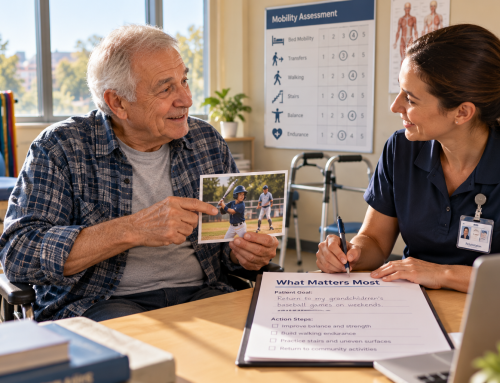
The Age Friendly Health Systems framework is built around the 4Ms: What Matters, Medication, Mentation, and Mobility (Institute for Healthcare Improvement, n.d.). What Matters asks care teams to understand each older adult’s health outcome goals and care preferences so care can be aligned with the person’s life, values, and priorities (Institute for Healthcare Improvement, 2023). In simpler terms, What Matters helps shift the conversation from “What is wrong with you?” to “What gives your life meaning, and how can care support that?”
This is deeply aligned with our humanity. What Matters is about being seen as a whole person before being viewed as a patient, resident, client, worker, student, or case file. Patient centered outcomes that matter most to older adults include autonomy, emotional health, daily living, social role function, participation in decision making, physical function, and quality of life (Andersson et al., 2024).
At Tellegacy, we believe What Matters should be practiced long before a person becomes an older adult. We are training future older adults, future health care workers, future leaders, and future community members to strengthen their own humanity while learning to honor the humanity of others.
The hidden problem with transactional training
For more than a century, many training systems inherited a transactional view of human beings. Scientific management placed efficiency, task standardization, and output at the center of work design (Taylor, 1911). That approach helped organizations scale, but when taken too far, it trained people to become conduits of production rather than whole people in relationship with one another.
This pattern still shows up today. Many organizations train for compliance, productivity, documentation, and risk reduction, yet they spend far less time training people to listen well, build trust, understand purpose, communicate across difference, support social connection, and protect dignity.
The issue is not that data, efficiency, or accountability are wrong. The issue is that performance without humanity eventually becomes fragile. In health care, that fragility can appear as burnout, turnover, loneliness, poor communication, mistrust, and care that fails to connect with what matters most.
The data is telling us the same thing
Social connection is no longer a “nice extra.” It is a health issue, a workforce issue, and a community issue. The National Academies reported that 24 percent of adults age 65 and older living in their communities are socially isolated, and more than one third of adults age 45 and older report loneliness (National Academies of Sciences, Engineering, and Medicine, 2020).
The U.S. Surgeon General’s advisory reported that chronic loneliness and social isolation can increase the risk of developing dementia by approximately 50 percent in older adults (Office of the Surgeon General, 2023). The advisory also described links between loneliness, depression, anxiety, cardiovascular risk, and premature mortality (Office of the Surgeon General, 2023).
Purpose matters as well. A systematic review found that purpose in life reflects life goals and the determination to pursue them, and purpose can motivate healthy behaviors during aging (AshaRani et al., 2022). A cohort study of adults over age 50 found that stronger life purpose was associated with lower all cause mortality (Alimujiang et al., 2019).
The workplace data points in the same direction. A meta analysis of meaningful work found strong relationships between meaningful work, work engagement, organizational commitment, and job satisfaction (Allan et al., 2019). Gallup’s Q12 meta analysis found that top quartile business units had 23 percent higher profitability, 18 percent higher sales productivity, lower turnover, lower absenteeism, fewer safety incidents, and better customer engagement than bottom quartile units (Gallup, 2024).
Employees are not becoming less focused. Many are becoming more discerning about where their focus should go. Once people experience work that values purpose, relationships, trust, growth, and human dignity, it becomes much harder to remain loyal to environments that treat them only as task performers.
What Zappos understood before many organizations did
Zappos became one of the clearest business examples of this shift. In Delivering Happiness, Tony Hsieh described how Zappos grew from almost no sales in 1999 to more than $1 billion in gross merchandise sales by 2008, with culture, customer service, and purpose becoming central to its growth story (Hsieh, 2010).
Zappos did several things that still matter for health care and education today.
First, the company treated customer service as the whole company’s responsibility rather than one department’s job (Hsieh, 2010). Everyone entering headquarters received customer service training, including employees who were not hired for customer service roles (Hsieh, 2010).
Second, Zappos trusted people to be human. The company avoided rigid scripts, did not measure call center success by call time, and encouraged employees to create personal emotional connections with customers (Hsieh, 2010).
Third, Zappos built culture intentionally. The company created a Culture Book, asked employees to describe what the culture meant to them, and used core values as operational commitments rather than wall decorations (Hsieh, 2010).
Fourth, Zappos connected business success to happiness, purpose, and belonging. Hsieh described happiness as connected to perceived control, perceived progress, connectedness, and vision or meaning (Hsieh, 2010).
This is the strategic lesson: Zappos did not abandon performance by focusing on humanity. It used humanity as the operating system that made performance more memorable, more trusted, and more scalable.
Other organizations are seeing the same pattern
Patagonia has long connected business decisions with environmental responsibility, employee wellbeing, and values driven culture. The company reports that its employees receive strong benefits, flexible work schedules, and paid time for environmental internships, while many employees share the organization’s environmental and community values (Patagonia, n.d.).
Mayo Clinic’s primary value is that the needs of the patient come first, and its values include respect, compassion, healing, teamwork, innovation, excellence, and stewardship (Mayo Clinic, n.d.). This matters because the values are not positioned as decorative language. They are presented as the foundation for how people work with patients, families, colleagues, and communities (Mayo Clinic, n.d.).
Cleveland Clinic has also invested in relationship centered communication. Its Communicate with H.E.A.R.T. model teaches caregivers to build compassionate communication through practical behaviors such as listening, empathy, relationship building, ownership, and appreciation (Cleveland Clinic, n.d.). Research on Cleveland Clinic’s system wide relationship centered communication training found improvements in patient satisfaction, physician empathy, and physician self efficacy (Boissy et al., 2016).
These examples point to a cultural shift. Many people are no longer looking for organizations that simply extract effort. They are looking for places where effort has meaning, relationships are respected, purpose is visible, and wellbeing is treated as part of excellence.
Why this matters so much in health care
Health care cannot afford to train people out of their humanity. The future of health care depends on people who can combine technical skill with dignity, cultural understanding, emotional presence, social connection, and practical wisdom.
This is especially true when working with older adults. What Matters requires more than a checklist. It requires a trained ability to notice the person, not only the condition. It requires curiosity about someone’s story, their roles, their hopes, their relationships, their losses, their strengths, and their desired contribution.
Intergenerational programs are one powerful way to build this capacity. A scoping review of intergenerational interventions involving university students and older adults found promising evidence for reducing loneliness, increasing social engagement, and strengthening student preparation for work with older adults (Holloway et al., 2024). A broader systematic review found that intergenerational activities can influence older adults’ mental health and wellbeing, while also noting the need for stronger study designs and clearer reporting (Whear et al., 2023).
Research on Experience Corps also supports the idea that purposeful intergenerational roles can support health. Older adult volunteers in Experience Corps reported fewer depressive symptoms and fewer functional limitations after two years when compared with a matched comparison group (Hong & Morrow Howell, 2010).
Ageism is part of this equation as well. A systematic review and meta analysis found that interventions combining education with intergenerational contact had the strongest effects on improving attitudes toward older adults (Burnes et al., 2019). This means universities should not wait until students enter clinical practice to help them understand aging, dignity, and human connection.
Blue Zones are more than geography
Blue Zones are often presented as geographic places where people live longer and healthier lives. The well known Blue Zones framework highlights common patterns among long lived communities, including natural movement, purpose, belonging, social connection, and supportive environments (Buettner & Skemp, 2016).
That geographic lesson is important, but the deeper lesson is transferable. In essence, a Blue Zone is a human ecosystem where people are more likely to live with connection, movement, purpose, contribution, and belonging. Blue Zones are places where people engage in What Matters together.
This means every university, health care organization, senior center, long term care setting, and community partner can become a Blue Zone builder. The goal is not to copy Sardinia, Okinawa, Nicoya, Ikaria, or Loma Linda. The goal is to create local environments where people are seen, needed, connected, and invited to live with purpose.
Tellegacy’s role in this movement
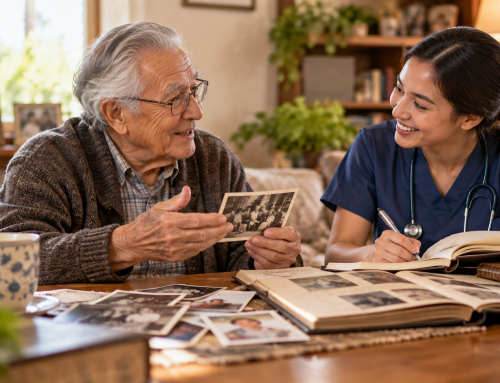
Tellegacy helps build these environments through intentional intergenerational connection. Students engage with older adults through structured conversations about life, legacy, meaning, and What Matters. Older adults are given space to share their stories, reflect on their values, and pass forward wisdom. Students learn that care begins with attention to the person.
This is workforce development, health promotion, and cultural renewal at the same time.
A Tellegacy trained student is not simply learning how to complete a volunteer activity. They are learning how to sit with a person, listen across generations, recognize social isolation, honor lived experience, and connect care to meaning. A Tellegacy partner organization is not simply adding a program. It is building a culture where older adults are treated as contributors to the future.
A practical What Matters training model
A strong What Matters training model should help students and staff develop skills in at least four areas.
Human presence: Learners practice listening, asking meaningful questions, and honoring silence.
Purpose recognition: Learners identify what gives a person energy, identity, contribution, and meaning.
Social connection: Learners understand loneliness, social isolation, belonging, and the health risks tied to disconnection.
Action alignment: Learners connect what they hear to practical supports, referrals, activities, relationships, and care plans.
This model helps people become better future professionals, better family members, better neighbors, and eventually better older adults themselves.
The future we can build on purpose
We are entering a time when society must decide whether aging will be treated as a burden to manage or a stage of life to honor. Tellegacy chooses honor.
We believe every older adult deserves opportunities to engage in What Matters most. We also believe every student should be trained to recognize humanity before they enter systems that may pressure them to become transactional.
The next generation of health care workers, educators, leaders, and community builders should know how to create places where people belong, contribute, remember, move, learn, laugh, and pass forward wisdom. That is the deeper meaning of becoming a Blue Zone creator.
Blue Zones may begin as geography. Tellegacy sees them as a practice.
Where people are connected around What Matters, humanity becomes the health intervention.
References
Allan, B. A., Batz Barbarich, C., Sterling, H. M., & Tay, L. (2019). Outcomes of meaningful work: A meta analysis. Journal of Management Studies, 56(3), 500, 528.
Alimujiang, A., Wiensch, A., Boss, J., Fleischer, N. L., Mondul, A. M., McLean, K., Mukherjee, B., & Pearce, C. L. (2019). Association between life purpose and mortality among US adults older than 50 years. JAMA Network Open, 2(5), e194270.
Andersson, Å. G., Dahlkvist, L., & Kurland, L. (2024). Patient centered outcomes and outcome measurements for people aged 65 years and older: A scoping review. BMC Geriatrics, 24, 528.
AshaRani, P. V., Lai, D., Koh, J., & Subramaniam, M. (2022). Purpose in life in older adults: A systematic review on conceptualization, measures, and determinants. International Journal of Environmental Research and Public Health, 19(10), 5860.
Boissy, A., Windover, A. K., Bokar, D., Karafa, M., Neuendorf, K., Frankel, R. M., Merlino, J., & Rothberg, M. B. (2016). Communication skills training for physicians improves patient satisfaction. Journal of General Internal Medicine, 31, 755, 761.
Buettner, D., & Skemp, S. (2016). Blue Zones: Lessons from the world’s longest lived. American Journal of Lifestyle Medicine, 10(5), 318, 321.
Burnes, D., Sheppard, C., Henderson, C. R., Wassel, M., Cope, R., Barber, C., & Pillemer, K. (2019). Interventions to reduce ageism against older adults: A systematic review and meta analysis. American Journal of Public Health, 109(8), e1, e9.
Cleveland Clinic. (n.d.). Leaders in patient experience.
Gallup. (2024). Q12 meta analysis: 11th edition.
Holloway, J., et al. (2024). Needs of social isolation, loneliness, and intergenerational interventions in the United States: A scoping review. Frontiers in Public Health, 12, 1386651.
Hong, S. I., & Morrow Howell, N. (2010). Health outcomes of Experience Corps: A high commitment volunteer program. Social Science & Medicine, 71(2), 414, 420.
Hsieh, T. (2010). Delivering happiness: A path to profits, passion, and purpose. Business Plus.
Institute for Healthcare Improvement. (n.d.). Age Friendly Health Systems.
Institute for Healthcare Improvement. (2023). What Matters to older adults? A toolkit for health systems to design better care with older adults.
Mayo Clinic. (n.d.). Mission and values.
National Academies of Sciences, Engineering, and Medicine. (2020). Social isolation and loneliness in older adults: Opportunities for the health care system. National Academies Press.
Office of the Surgeon General. (2023). Our epidemic of loneliness and isolation: The U.S. Surgeon General’s advisory on the healing effects of social connection and community.
Patagonia. (n.d.). A history of our environmental and social responsibility.
Taylor, F. W. (1911). The principles of scientific management. Harper & Brothers.
Whear, R., Thompson Coon, J., Bethel, A., Abbott, R., Stein, K., & Garside, R. (2023). What is the effect of intergenerational activities on the wellbeing and mental health of older people? A systematic review. Campbell Systematic Reviews, 19(3), e1355.