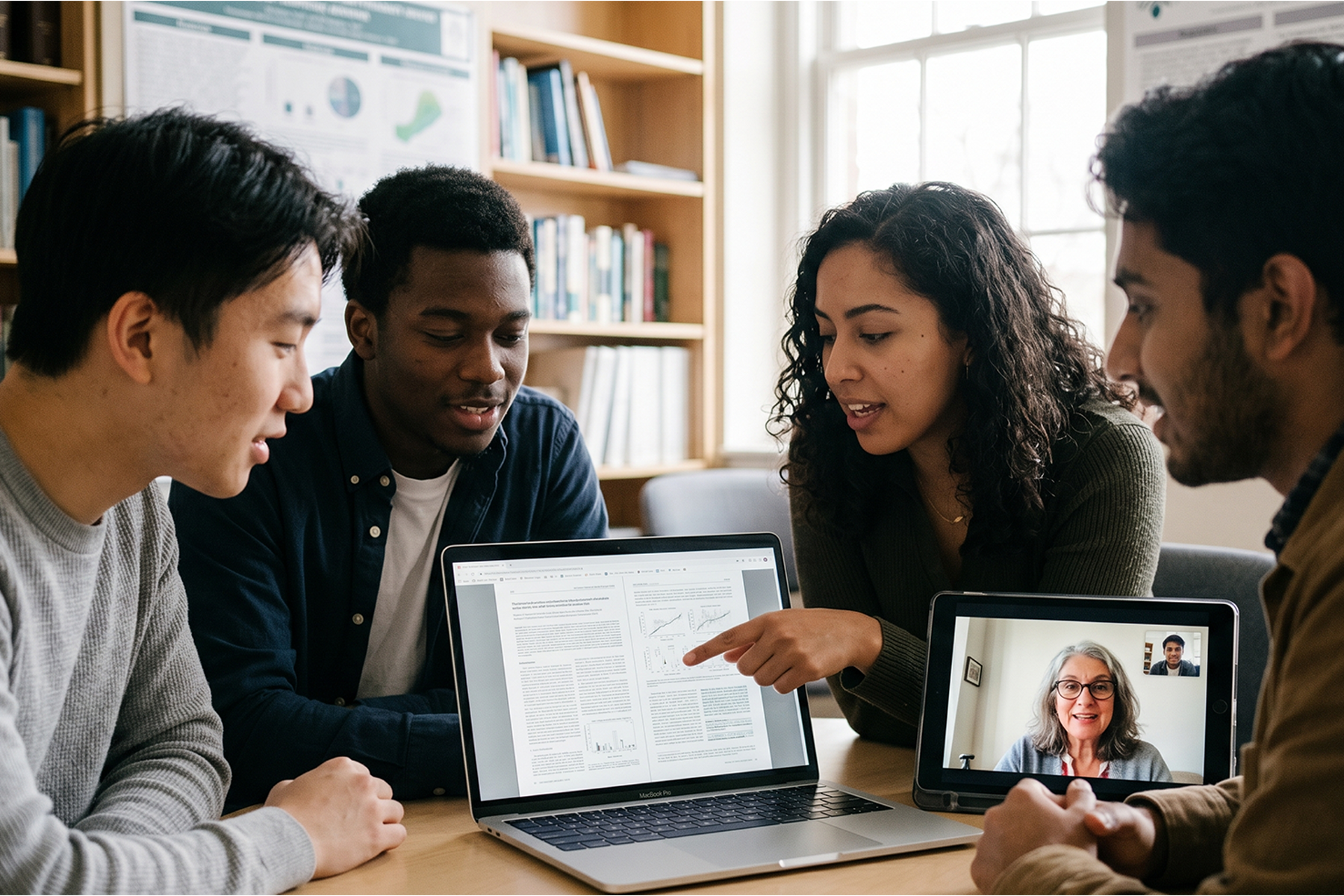
Tellegacy congratulates Dr. Jeremy Holloway and Tellegacy intern scholars Loveth Johnson, Alesha Vincent, Yasmine Mustafa, and former intern Owais Sayeed for their contributions to a newly published article in Discover Public Health.
The article, “Lessons learned from an intergenerational health promotion program focused on virtual community engagement,” examines how structured virtual engagement can support older adults living with Alzheimer’s disease and related dementias while helping students build confidence, empathy, and interest in aging-related careers.
This publication is also a meaningful reflection of Tellegacy’s mentorship model.
Tellegacy’s work has always centered on connection across generations. This article shows another layer of this mission: training students, interns, and emerging scholars to become future researchers, program leaders, and intergenerational health promotion experts.
The article in its entirety can be read here: https://link.springer.com/article/10.1186/s12982-026-02075-x
Why This Study Matters Now
Social isolation and loneliness among older adults are major public health concerns. These challenges become even more urgent for people living with Alzheimer’s disease and related dementias, who may face additional barriers to communication, routine social contact, and meaningful engagement.
At the same time, many university students need more hands-on pathways into aging, dementia care, public health, healthcare, social science, and community-based research.
This study brings these two needs together.
It shows how a virtual intergenerational program can create structured social connection for older adults while helping students grow as communicators, future professionals, and researchers.
For universities, publishers, health systems, and aging-services organizations, this is the larger story: intergenerational programs can become a training ground for the next generation of healthcare leaders.
About the Published Paper
The article focused on Virtual TimeOut@UCLA, an intergenerational health promotion program that paired undergraduate students with older adults living with Alzheimer’s disease and related dementias for structured weekly virtual sessions.
The program included:
- Student recruitment through university partnerships and aging-related learning opportunities
- Student training using communication videos and supporting materials
- Older adult recruitment through dementia care pathways
- Careful matching based on shared interests, background, culture, and language
- Weekly virtual engagement over a 10-week period
- Student reflection and documentation after each encounter
The model is powerful because it is simple, structured, and human-centered.
Students were not simply completing a task. They were learning how to listen, communicate, adapt, and build relationships with older adults in a meaningful way.
What the Study Found
The study used a mixed-methods evaluation that included student surveys and caregiver interviews.
The student outcomes were especially encouraging.
Among undergraduate participants, Dementia Attitudes Scale scores increased from a retrospective pre-program mean of 95.7 to a post-program mean of 121.5. This 25.8-point increase suggested more positive attitudes toward people living with dementia after participation.
Students also reported greater confidence in working with older adults. In fact, 100% of students reported improvement in their perceived ability to work with older adults living with dementia.
Caregivers also described meaningful benefits for their loved ones.
Across caregiver interviews, recurring themes included improved mood, stronger engagement, greater focus, and more emotional responsiveness following student interactions.
One of the strongest takeaways is this: connection is measurable, but it is also deeply human.
The data matters. The stories matter too.
The Mentorship Behind the Publication
This publication represents more than one research article.
It reflects the mentorship aspect of Tellegacy’s healthcare research program and the intentional development of student scholars.
Dr. Holloway contributed to the article through original drafting, review and editing, and supervision. Tellegacy interns and student scholars contributed through review, editing, figures, conceptual models, and tables.
Each contribution matters.
Loveth Johnson contributed to writing review, editing, and visualization through figures and conceptual models.
Yasmine Mustafa contributed to writing review, editing, and visualization through figures and tables.
Alesha Vincent contributed to writing review and editing.
Owais Sayeed, a former Tellegacy intern, contributed to writing review and editing.
This is what mentorship looks like when it moves from conversation to publication.
Students are not only learning about research. They are contributing to it.
Tellegacy’s Larger Role in the Field
Tellegacy leaders are intergenerational program experts because they understand both sides of the work.
They understand the program side: how to build meaningful relationships between students and older adults.
They also understand the research side: how to evaluate outcomes, communicate findings, mentor emerging scholars, and move the field forward.
This combination is rare and needed.
The future of aging services will require more than good intentions. It will require trained professionals who understand social connection, dementia care, communication, health equity, technology, and measurable outcomes.
Tellegacy is helping prepare those professionals.
Why Universities Should Pay Attention
Universities are searching for learning experiences that are meaningful, measurable, and connected to real-world health challenges.
Intergenerational programs offer a strong answer.
They can help students develop:
- Communication skills
- Empathy and patience
- Interest in aging-related careers
- Confidence working with older adults
- Research and evaluation experience
- Understanding of dementia, social isolation, and community health
These are not soft outcomes. These are workforce outcomes.
As the older adult population grows, universities have an opportunity to prepare students for one of the most important public health challenges of the coming decades: how to support aging well with dignity, connection, and purpose.
Why Publishers Should Pay Attention
For book publishers, this work points to a larger cultural and educational shift.
Intergenerational connection is becoming a public health strategy, a workforce development strategy, and a research training strategy.
This creates a timely opportunity for accessible books, training guides, university curricula, and public-facing resources that help translate research into practice.
The field needs writing that can speak to universities, healthcare leaders, caregivers, students, and older adults at the same time.
Tellegacy’s work sits at this intersection.
A Human-Centered Path Forward
The study also reminds us to stay humble.
The authors note that larger and more diverse studies are needed. Future research should include more direct feedback from older adult participants when feasible, as well as longer-term follow-up and additional outcome measures.
This is how strong fields grow.
One study opens the door. Mentorship brings more researchers through it.
Tellegacy congratulates Dr. Holloway, Loveth Johnson, Alesha Vincent, Yasmine Mustafa, and Owais Sayeed for contributing to this important publication and for helping strengthen the future of intergenerational health promotion research.
About Tellegacy
Tellegacy is an intergenerational program that connects students and older adults through structured conversation, storytelling, reflection, and relationship-building.
Through training, mentorship, research, and program implementation, Tellegacy helps students develop age-friendly skills while supporting meaningful connection for older adults.
Universities, healthcare organizations, aging-services providers, and researchers interested in intergenerational programming, social connection, and healthcare workforce development are invited to learn more about Tellegacy’s work.
Frequently Asked Questions
What is intergenerational health promotion?
Intergenerational health promotion uses structured relationships between generations to support health, learning, connection, and well-being. These programs often connect students or younger adults with older adults through conversation, shared activities, storytelling, or service-learning.
Why are virtual intergenerational programs important?
Virtual programs can reduce access barriers for older adults, students, caregivers, and organizations. They can support connection when transportation, geography, health status, or scheduling make in-person engagement difficult.
How do students benefit from intergenerational programs?
Students can develop stronger communication skills, greater empathy, increased confidence working with older adults, and deeper interest in healthcare, aging, dementia care, public health, and research careers.
How do older adults benefit?
Older adults may experience meaningful social engagement, improved mood, increased conversation, and a stronger sense of connection. For people living with dementia, structured interaction can provide emotional and cognitive stimulation when designed with care.
How does Tellegacy support student researchers?
Tellegacy supports students through mentorship, writing opportunities, research collaboration, program evaluation, and practical experience in intergenerational health promotion.