Published research examines how structured conversations between nursing students and older adults can strengthen social connection, communication, and community-centered learning.
Every person carries a story worth hearing. When someone takes the time to listen with care, that story can become a source of connection, learning, and purpose across generations.
We are pleased to share the publication of a new Tellegacy study in Health & Social Care in the Community:
“Social Care Curriculum: Lessons Learned From a Community-Based Program to Address Intergenerational Needs of Older Adults.”
The open-access article was written by Jeremy Holloway, Yasmine Mustafa, Reyna Acosta, Owais Sayeed, Christine Ringhiser, and Lynn Shaffer and published on September 26, 2026.
You can read the full open-access article here:
Social Care Curriculum: Lessons Learned From a Community-Based Program to Address Intergenerational Needs of Older Adults
Bringing social care into health-professions education
The study examined Tellegacy as a community-based social care curriculum for undergraduate nursing students and older adults in the Columbus, Ohio, area.
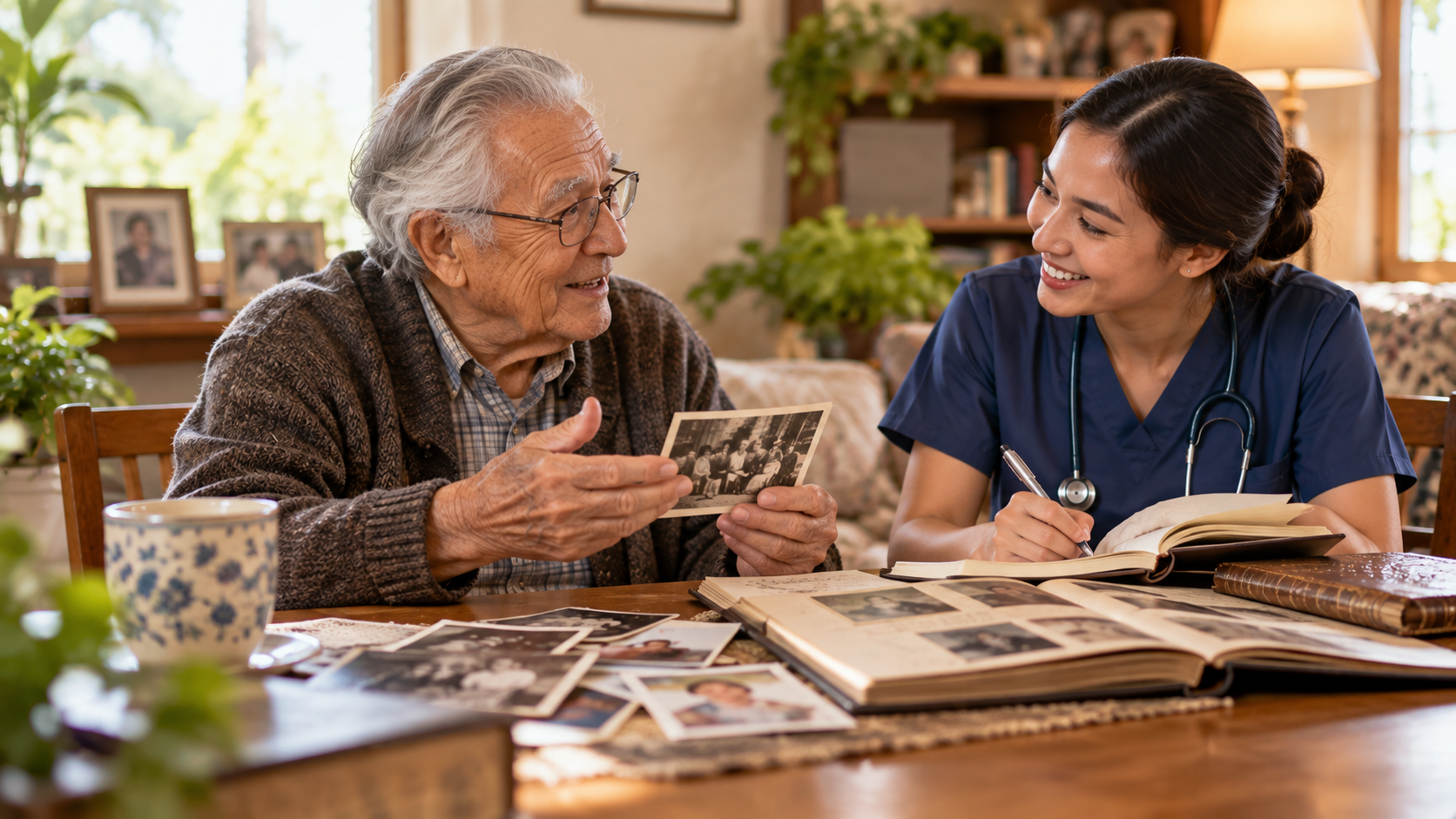
A total of 98 nursing students—known within Tellegacy as Legacy Builders—were paired with older adults for a series of structured conversations. Before beginning, the students received training in active listening, mindfulness, empathy, goal setting, growth mindset, reminiscence, and legacy interviewing.
Across approximately eight sessions, students and older adults explored life experiences, personal strengths, meaningful goals, and lessons worth carrying into the future. Their conversations culminated in personalized legacy books that preserved each older adult’s story for family members and future generations.
This structure allowed students to practice essential relationship-centered skills while creating space for older adults to share their experiences, wisdom, and perspectives.
What the study found
Seventy-three older adults completed both the preprogram and postprogram assessments used in the study. Median loneliness scores decreased, while median life-satisfaction scores increased. Although the quantitative changes were not statistically significant, the findings trended positively in the direction of desirable changes in loneliness or life satisfaction.
The qualitative findings revealed another important dimension of the experience.
Older adults described meaningful relationships, emotional support, increased confidence communicating across generations, and appreciation for the genuine interest students showed in their lives. Some participants learned to text, share photographs, use social media, or connect through Zoom. Several relationships continued after the formal program ended through weekly conversations, coffee, or lunch.
One older adult came to think of her Legacy Builder as another granddaughter. Another participant described the experience simply as:
“Superb! Great! Very rewarding!”
Students gained opportunities to practice listening, empathy, reflection, and communication in the context of an ongoing human relationship. Older adults contributed insight, encouragement, and life experience to the education of future nurses. This reciprocity is central to Tellegacy: each generation enters the relationship with something meaningful to offer.
Why these lessons matter
The study offers several important lessons for health-professions education and community-based social care.
First, social care skills can be intentionally taught, practiced, and strengthened. Active listening, empathy, meaningful conversation, and relationship building are essential parts of caring for people and communities.
Second, structured intergenerational programs can create a bridge between academic learning and human experience. Students have an opportunity to understand older adults as complete individuals whose identities include relationships, goals, histories, abilities, and hopes.
Third, meaningful connection requires more than placing two people in contact. Preparation, continuity, guided reflection, and opportunities for reciprocal learning help create the conditions in which trust can grow.
Finally, the findings demonstrate the value of listening to both outcome measures and participant experiences. Quantitative measures provide one important view of a program’s effects. Personal reflections help us understand how connection is experienced, what participants value, and how programs can continue to improve.
Building the next stage of evidence
This publication strengthens the foundation for the next stage of Tellegacy research.
Future studies can build upon these lessons through larger and more diverse participant groups, multiple implementation sites, comparison conditions, longer-term follow-up, and additional measures of communication and social-care competencies. These designs can help determine which elements of structured intergenerational engagement are most effective, for whom, and under what conditions.
The study also points toward a valuable opportunity for universities, healthcare organizations, and aging-service partners: preparing future professionals to understand social connection as part of community health and person-centered care.
With gratitude
This work was made possible by the older adults who shared their experiences, the nursing students who entered each conversation with curiosity and care, and the educators, social-care professionals, partners, and research team members who supported the program.
Their participation reminds us that intergenerational connection is built one conversation at a time, and that listening carefully to another person’s story can shape how we learn, how we care, and how we understand one another.
Read the full open-access article:
Social Care Curriculum: Lessons Learned From a Community-Based Program to Address Intergenerational Needs of Older Adults
Citation:
Holloway, J., Mustafa, Y., Acosta, R., Sayeed, O., Ringhiser, C., & Shaffer, L. (2026). Social care curriculum: Lessons learned from a community-based program to address intergenerational needs of older adults. Health & Social Care in the Community, 2026, Article 6758518. https://doi.org/10.1155/hsc/6758518