One of the most common misunderstandings about internships begins with a reasonable expectation: I am here to learn.
Of course interns are there to learn. The more important question is how that learning is expected to happen.
A course and an internship can both be educational experiences, yet they usually create learning in very different ways. A course primarily develops knowledge and skills through instruction. An internship primarily develops professional capability through application, experience, contribution, feedback, and reflection.
The National Association of Colleges and Employers defines an internship as experiential learning that integrates knowledge and theory learned in the classroom with practical application and skills development in a professional setting. In other words, the classroom and the internship are designed to complement each other. One develops much of the foundation. The other creates an environment in which that foundation can be used.
A useful way to understand this difference is what we call the 80/20 rule.
The 80/20 Rule
Think of the 80/20 rule as a practical framework for understanding the primary purpose of each experience.
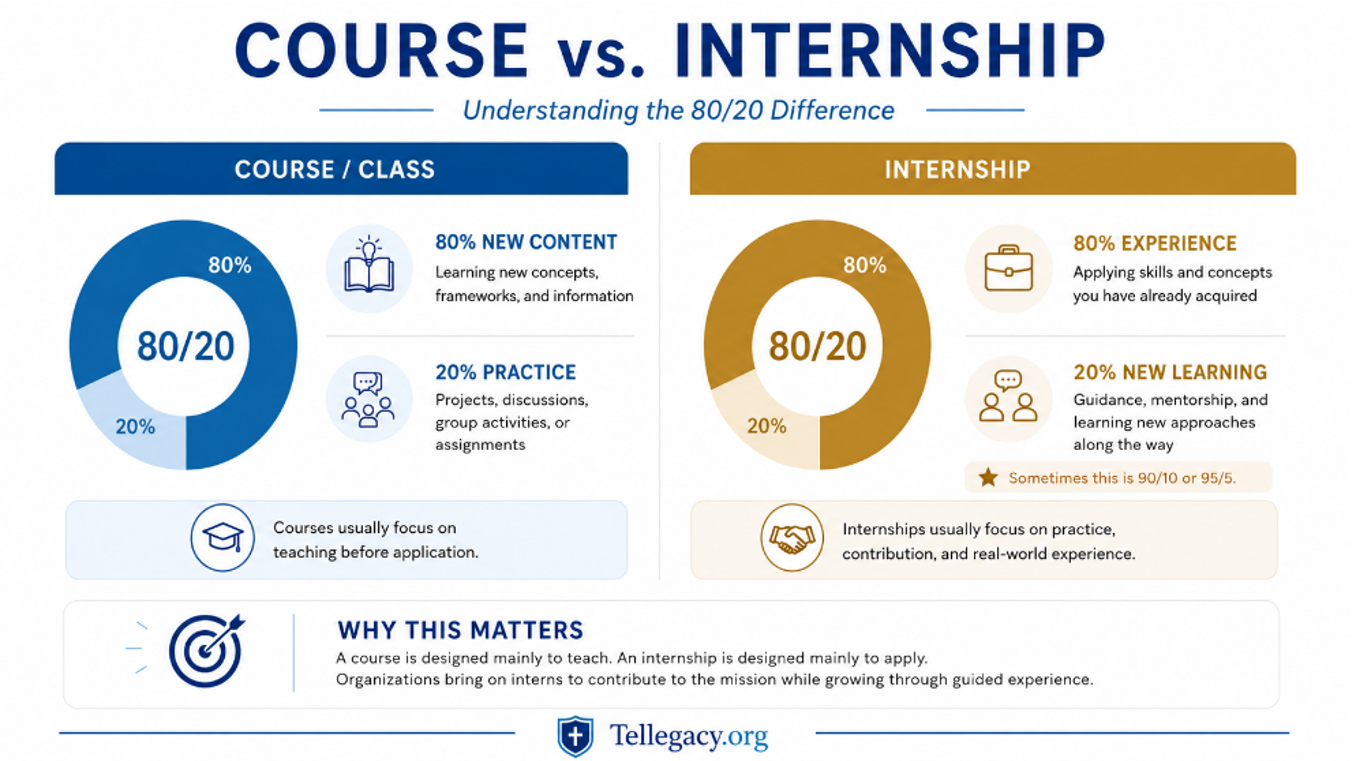
A Course: Approximately 80% Learning and 20% Application
Students generally enroll in a course because they do not yet possess all of the knowledge the course is designed to teach.
Unless prerequisites are required, the instructor expects to introduce concepts, theories, frameworks, methods, terminology, and skills that may be new to the learner.
The primary flow looks something like this:
80% receiving and developing new knowledge
20% practicing and applying that knowledge
Application may occur through research assignments, laboratory exercises, group projects, case studies, presentations, simulations, discussions, or other activities.
Some courses are intentionally designed to provide considerably more experiential learning. Clinical education, laboratory courses, practicums, project based programs, and other experiential models may approach something closer to a 50/50 balance.
The central purpose, however, remains educational development.
The institution is primarily saying:
We will teach you something you are here to learn.
An Internship Reverses the Equation
A strong internship generally begins from a different assumption.
The student has already spent time developing knowledge and skills through coursework, previous employment, research, volunteering, independent learning, or other preparation.
Now comes the opportunity to use them.
A useful expectation is:
80% applying existing knowledge and skills through real experience
20% developing new knowledge, approaches, and professional skills through mentorship and experience
In some internships, the balance may look closer to 90/10 or even 95/5.
The exact percentage matters less than the direction of the experience.
An internship is primarily an application environment.
This aligns closely with NACE’s description of internships as experiences that provide a real world opportunity to apply classroom knowledge while developing transferable skills under professional supervision.
The U.S. Department of Labor similarly describes internships as opportunities for students to gain on the job training and experience related to their fields while pursuing their education.
The Difference Is Where the Learning Happens
This distinction becomes clearer when we ask a simple question:
Where is the learner expected to acquire the foundation?
In a course, much of the foundation is acquired during the experience.
In an internship, much of the foundation is expected to have been acquired before the experience, with professional development continuing through application.
Consider a student studying communications.
A course may teach the student how to identify audiences, develop messaging, write professionally, analyze communication strategies, and evaluate campaigns.
An internship may then ask that student to:
create outreach materials,
research potential audiences,
draft professional communications,
analyze engagement data,
support a campaign,
participate in meetings,
and revise work based upon professional feedback.
The internship certainly continues the student’s learning. But the learning increasingly occurs through doing the work.
That distinction is fundamental.
An Internship Is a Reciprocal Value Exchange
This is also what makes internships valuable to both students and organizations.
The intern receives something extremely valuable: access to authentic professional environments where academic knowledge becomes professional capability.
The organization also receives value.
Interns contribute ideas, research, technical abilities, creativity, energy, disciplinary knowledge, and time toward meaningful organizational objectives.
This reciprocity matters.
A company does not typically create an internship simply to reproduce a semester long course inside its organization. It brings an intern into an environment where that person can participate in real work, with appropriate guidance, mentorship, supervision, and feedback.
NACE emphasizes both sides of this relationship. Internships provide students with applied experience and professional connections while also providing employers with access to emerging talent and opportunities to guide and evaluate potential future candidates.
This creates a powerful equation:
Preparation + Application + Mentorship = Professional Growth
Mentorship Does Not Replace Preparation
Mentorship is one of the most important elements of a high quality internship.
A mentor can help an intern understand organizational culture, refine professional judgment, improve communication, solve unfamiliar problems, receive feedback, and learn approaches that are difficult to teach in a textbook.
Mentorship works best when there is already something to mentor.
An intern entering a communications position, for example, should ideally arrive with some foundation in writing, audience analysis, research, communication, or related skills. The internship then creates the environment where those capabilities become stronger, faster, more strategic, and more professional.
The organization provides context, guidance, feedback, opportunity, and experience.
The intern brings preparation, capability, curiosity, effort, and contribution.
Both sides participate in the learning process.
A Simple Test: What Is the Primary Direction of Value?
There is another useful way to distinguish a course from an internship.
Ask:
What is the primary direction of value?
In a course, the institution primarily delivers educational value to the learner.
The professor teaches. The student studies. The institution evaluates whether learning occurred.
In an internship, value flows in both directions.
The organization provides experience, access, mentorship, feedback, professional context, and opportunities.
The intern applies existing capabilities toward work that contributes to organizational goals.
This explains why approaching an internship primarily by asking, “What are you going to teach me?” can create a mismatch in expectations.
A stronger question is:
“What can I contribute with what I already know, and what can I learn by applying it here?”
That is the mindset of experiential learning.
Why Internship Interviews Matter
This distinction also explains why organizations interview internship candidates.
An internship interview is partly about potential, but it is also about readiness.
Organizations are evaluating questions such as:
What can this person already do?
What academic or professional knowledge can this person apply?
Can this candidate work with appropriate independence?
Can this individual communicate effectively?
Can this person contribute to the projects we actually need completed?
Will mentorship accelerate this person’s capabilities?
At Tellegacy, we have encountered internship candidates who initially approached the opportunity as though the internship itself would primarily provide new instructional content.
Clarifying the distinction early creates better experiences for everyone.
The .
The classroom prepared the learner.
The internship provides the arena.
If the Experience Is Primarily Instruction, It Starts to Resemble a Course
There is an economic logic behind this distinction as well.
Students typically pay educational institutions because those institutions organize faculty, curriculum, instructional materials, assessments, and learning environments specifically to teach them.
An internship operates through a different value proposition.
The organization invests supervision, mentorship, access, professional experience, and staff time while the intern contributes meaningful effort and applicable capability.
If an organization spent the overwhelming majority of an internship delivering basic instruction while receiving little meaningful application or contribution, the experience would begin to resemble training or coursework more than a traditional internship.
This is why readiness matters.
The intern does not need to arrive knowing everything.
They do need to arrive prepared to use something.
The Best Internships Still Produce Tremendous Learning
The 80/20 framework does not diminish the educational value of internships.
It explains why internships can be so powerful.
Applying knowledge reveals things that classroom learning alone cannot always reveal.
A communication strategy behaves differently when a real audience responds to it.
Research feels different when organizational decisions depend upon the findings.
Teamwork changes when colleagues have deadlines and responsibilities.
Writing changes when the document will actually be sent to a partner.
Problem solving changes when there is no answer key.
Professional identity begins to develop when students discover that their knowledge can create value beyond the classroom.
That is experiential learning at its best.
From “Tell Me What to Do” to “Here Is What I Can Contribute”
The transition from course to internship is ultimately a transition in professional mindset.
The course mindset often begins with:
What am I going to learn?
The internship mindset adds a second question:
What am I prepared to contribute?
That shift is significant because professional life increasingly rewards the ability to integrate both.
Strong professionals remain lifelong learners. They ask questions, seek mentorship, acquire new skills, and remain open to correction.
They also enter organizations prepared to create value.
The internship is one of the first places where students learn how to do both simultaneously.
The 80/20 Difference
The distinction can be summarized simply:
Course
80% New Knowledge
Learn concepts, theories, frameworks, and skills.
20% Application
Practice through projects, assignments, research, simulations, and activities.
Internship
80% Application and Experience
Use existing skills and knowledge to participate in meaningful professional work.
20% New Learning
Develop through mentorship, feedback, challenges, observation, and new experiences.
The ratios will naturally vary across disciplines, institutions, employers, and individual programs. The value of the framework is the expectation it establishes.
A course prepares you to know.
An internship challenges you to use what you know.
And the strongest educational pathways deliberately connect the two.
The Larger Opportunity
When universities, students, and internship partners understand this distinction, internship experiences can become considerably stronger.
Faculty can prepare students for application.
Students can enter organizations ready to contribute.
Organizations can design meaningful projects instead of improvised activities.
Mentors can spend more time developing professional judgment and less time recreating foundational coursework.
And students leave with something that neither a course nor an internship can produce as effectively alone:
knowledge that has been tested through experience.
That is where education begins to become professional capability.
References
National Association of Colleges and Employers. (2026). What is an internship? Internship meaning and definition: A NACE guide.
U.S. Department of Labor. (2026). Students and recent graduate opportunities.